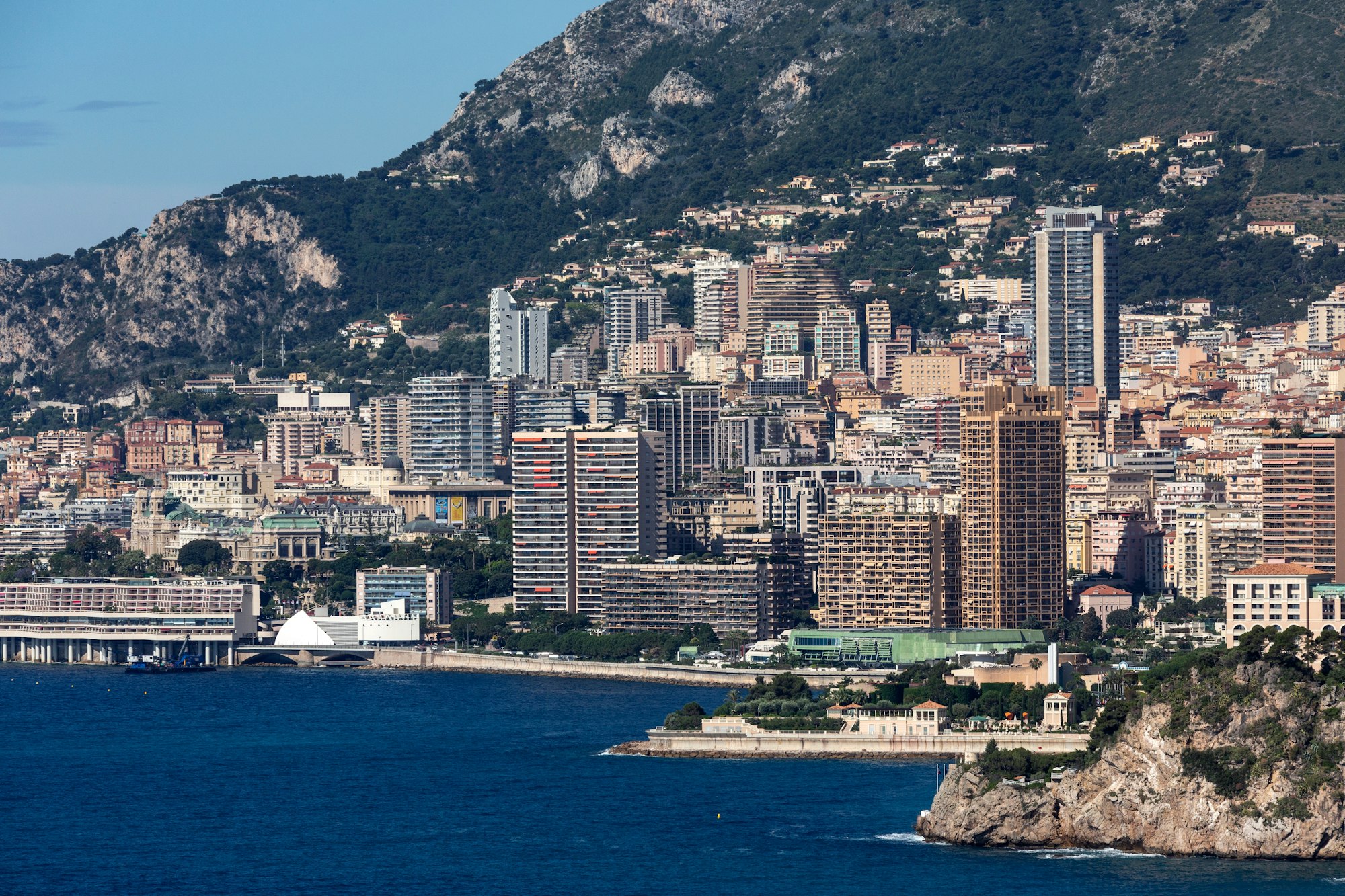
Driving along the Basse Corniche from Nice, Monaco always feels like a different planet the moment you cross the border, glossier cars, taller cranes, and property prices that make even seasoned Riviera watchers like us pause.
Monaco remains the most expensive real estate market on the planet, with average prices around €57,500 per square metre in 2025 and new developments pushing well past €65,000. Buying there means navigating a small, opaque, agent-driven market unlike almost anywhere else, but it also comes with a tax framework that explains why demand never really cools.
What you’ll find in this guide:
- Current price levels and why land scarcity keeps pushing them up
- How a purchase actually unfolds, step by step
- What Monaco’s tax regime does and doesn’t cover
- Renting versus buying, and what buyers should weigh before committing
The Monaco market at a glance
Monaco is the world’s second-smallest sovereign state after Vatican City, packed into barely two square kilometres, yet it consistently ranks as the most expensive city on Earth for real estate. Recent industry data puts the 2025 average around €57,569 per square metre, down slightly from €58,402 in 2024, while newly built properties averaged closer to €65,602 per square metre.
Prices vary sharply by district. Larvotto, driven partly by the Mareterra development, became the first district to cross €70,000 per square metre. Fontvieille, La Condamine and Monte-Carlo each have their own pricing logic, so a per-square-metre average tells you less than a district-by-district comparison would.
| Metric | Monaco, 2025-2026 |
|---|---|
| Average price per m², all properties | Around €57,500 |
| Average price per m², new developments | Around €65,600 |
| Highest district (Larvotto) | Over €70,000 per m² |
Source: Monaco real estate market data published by local specialist agencies, 2025-2026 figures.
What drives this isn’t mystery: near-zero available land, a tax framework built around residency rather than property, a stable political system, and a steady stream of wealthy buyers looking to establish a base on the Mediterranean.
How a purchase actually happens
Buying in Monaco follows a distinct rhythm compared to a standard French transaction. Properties rarely appear on public portals, most circulate quietly through a handful of established agencies with the right contacts, which makes an experienced local agent close to essential rather than optional.
Once you’ve identified a property, the agent prepares a sale agreement, which then needs notarisation. A deposit reserves the property, and the process concludes with a deed of sale signed before a Monaco notary. Compared to a typical purchase in mainland France, expect fewer public listings, more discretion, and a market where relationships matter as much as the paperwork itself.
Understanding the tax picture
Monaco has no income tax and no property tax for residents, which explains a large share of its appeal. That said, buying isn’t free of cost: a stamp duty (droits d’enregistrement) applies to real estate transactions, and rates depend on how the purchase is structured, directly in your name or through a corporate entity, a distinction that changes the tax outcome considerably and is worth clarifying with a Monaco-based notary before signing anything.
This is genuinely a case where “no property tax” doesn’t mean “no cost of entry.” Between agency fees, notary fees and registration duties, buyers should budget several percentage points of the purchase price beyond the sale figure itself, in line with what applies across most of the French-speaking real estate market nearby.
Inheritance and gift taxation also work differently in Monaco depending on the family relationship between the parties involved, another area where the local rules diverge noticeably from mainland France and genuinely warrant a conversation with a notary before any purchase structure is finalised, not after.
Renting versus buying in Monaco
Renting suits people who aren’t ready to commit long-term or who plan a shorter stay, and given how tight the sales market is, decent rentals still move fast. Buying makes more sense if you’re planning to establish genuine roots, given the combination of strong demand and land scarcity that has historically supported values over time.
Neither choice is automatically better. It depends on how long you intend to stay, how liquid you need your capital to remain, and whether the tax residency benefits of living in Monaco actually apply to your personal situation, which is a question for a tax advisor, not a blog.
Rental availability is also worth a mention on its own. Because so few properties change hands each year, decent rentals in central districts get snapped up quickly, often before they’re properly advertised. If renting first while you scout the market is your plan, expect to move fast once something suitable comes up, the usual “take a few weeks to think it over” approach doesn’t really work here.
Why an experienced agency matters here more than elsewhere
Monaco’s real estate market runs on relationships and discretion rather than public listings. A well-connected local agency knows which properties are about to come available before they’re advertised anywhere, and can guide you through regulations that differ meaningfully from mainland French property law.
We’ve written separately about what to look for when choosing a luxury real estate agency on the Riviera and in Monaco, since the criteria overlap a lot: track record, network, and genuine local knowledge matter more than a flashy office.
Beyond the numbers: why people actually choose Monaco
Monaco isn’t just a favourable tax regime with a nice view. The calendar alone, the Grand Prix, the Monte-Carlo Opera, a packed cultural and sporting agenda, makes it a genuine draw independent of the financial case. For many buyers, that lifestyle argument matters as much as the investment one.
If Monaco’s density and pace feels a bit much, we’ve also looked at how historic and modern properties compare as an investment there, which digs further into the property side specifically rather than the lifestyle picture.
Frequently asked questions
Do foreigners face restrictions buying property in Monaco? No general nationality-based restriction exists, though the process typically requires working through a licensed local agent and notary, and funding sources are scrutinised closely under anti-money-laundering rules.
Is Monaco property a safe long-term investment? Land scarcity and consistent demand have historically supported price stability, though “safe” still means high entry cost and limited liquidity if you need to sell quickly.
How does Monaco’s tax regime differ from mainland France? Monaco residents pay no income tax and no annual property tax, unlike France, but transaction-related fees such as stamp duty and notary costs still apply at purchase.
Buying in Monaco is a serious financial decision that deserves proper professional advice, from a local notary, a tax specialist and an established agency, well beyond what any general article can responsibly cover. We’re simply sharing what we’ve observed as Riviera-based property enthusiasts, not offering an investment recommendation.
Article updated in July 2026.